ANATOMY
OBLIQUES

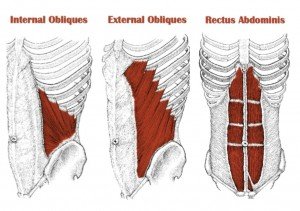
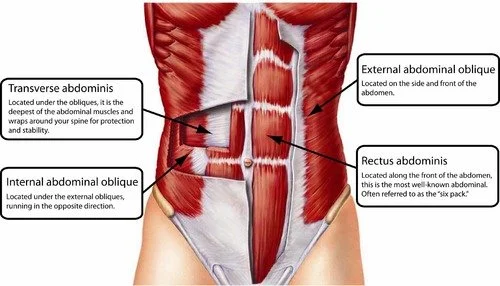
OBLIQUES
Rotation, Control, and Direction
The obliques are made up of two muscles on each side of the body:
Internal obliques
External obliques
They work as a pair.
The right and left obliques always work together to rotate, stabilize, and return the body to center. Because of this, it is impossible to completely isolate one oblique or completely shut the other off. Even in unilateral work, both sides are active.
Your job as an instructor is not to promise isolation.
Your job is to direct tension, name the focus, and coach intention.
HOW OBLIQUES WORK IN CLASS
Oblique workques are part of the core system, not separate from it.
In all oblique work, the following are also involved:
Rectus abdominis
Transverse abdominis
Hip flexors
Deep spinal stabilizers
Oblique work is essentially core work with direction.
Because obliques are short, flat muscles, they:
fatigue faster
do not require long sets to reach failure
respond strongly to tempo, pulses, and small ranges
UNILATERAL OBLIQUE WORK (WHAT TO SPEAK TO)
Since both obliques are always working, deciding which oblique to cue comes down to where the most tension is being created.
Consider:
direction of rotation or side bend
where the resistance or prop is placed
where the client feels the most effort
You should always cue the oblique that is under max tension, even though both will be felt.
PRACTICAL EXAMPLES
Supine Bicycle Oblique Crunch
Left internal oblique flexes to bring the right shoulder across midline
Right external oblique assists and works to control the return to center
If a ball is placed between the left knee and right elbow and pulsed:
Left internal oblique is under greater fatigue
Right external oblique is still active, but secondary
Cue the left oblique, while acknowledging that both sides are working.
Kneeling Side Bend with Cable (Right Hand Holding Cable)
Side bending left emphasizes the left internal oblique
Added resistance on the right increases load on the right external oblique
In this case:
Both sides are working hard
You may cue either, depending on where tension is greatest
The rule: cue the side working hardest, not the side you planned on paper.
INTERNAL OBLIQUES
Location
Deep to the external obliques (middle abdominal layer)
Fiber Direction
Run upward and inward (perpendicular to external obliques)
Primary Functions
Rotate trunk to the same side
Side bend to the same side
Assist spinal flexion
Support core stability and forceful exhalation
Example
Right internal oblique rotates torso to the right
Right rib cage bending toward right hip
EXTERNAL OBLIQUES
Location
Most superficial abdominal layer
Fiber Direction
Run downward and inward (“hands in pockets”)
Primary Functions
Rotate trunk to the opposite side
Side bend to the same side
Assist spinal flexion
Support posture and breathing
Example
Right external oblique rotates torso to the left
INSTRUCTOR STANDARD
You are responsible for:
understanding that both obliques always work together
cueing direction, not isolation
identifying where max tension lives
using props and resistance intentionally
keeping oblique work short, controlled, and precise
Oblique work should feel:
targeted
controlled
fatiguing
intentional
OBLIQUES — RUBRIC
Score each category 1–5
(1 = missing | 3 = inconsistent | 5 = excellent)
1) Anatomical Accuracy ____/5
Instructor correctly understands and explains internal vs external oblique function.
2) Directional Cueing ____/5
Cues clearly match the direction of rotation or side bend being performed.
3) Tension Awareness ____/5
Instructor cues the oblique under greatest tension, not just the “named” side.
4) Integration with Core ____/5
Core, breath, and stabilization are consistently layered into oblique work.
5) Programming Precision ____/5
Oblique work is appropriately short, controlled, and effective (no overworking).
6) Corrections + Coaching ____/5
Instructor recognizes compensation and redirects tension back into the obliques.
TOTAL: ____ /30
Notes:
Cue that worked well:
Opportunity to improve clarity or direction: