


Training guidance
Modifications by format
Every class format in The DRIP has its own equipment, movement patterns, and demands. These are the universal truths for each one — the modifications that apply across the board so you always know how to adapt intelligently, whatever class you're in.
Stay at your own tempo and choose lighter weights
Heart rate elevates more quickly during pregnancy and breathlessness comes sooner than usual. For any move that's intended to significantly raise the heart rate, you can stay slow and work at your own pace. Choose lighter weights or no weights, and skip overhead movements if they make your heart rate uncomfortably high.
Modify planks to knees or tabletop bird dogs
Static planks are generally considered safe in pregnancy, but depending on fitness level, belly size, and form, they can create too much abdominal pressure or wrist discomfort. Modify to knees or bird dogs. Postpartum, planks are also one of the hardest things to return to — keep the modification until deep core strength is rebuilt.
Prioritise deep core over six-pack work
Focus on exercises that strengthen the transverse abdominis — the deep core muscles that draw the belly toward the spine and also support bearing down during labor. Stabilising exercises that challenge balance work the same muscle. Avoid trunk-flexion moves like crunches, which activate the rectus abdominis (the six-pack muscles) and become increasingly ineffective and potentially uncomfortable as the belly grows.
Bear plank, bird dogs, dead bugs, heel digs, bridges
These moves train the deep core effectively without loading the linea alba or creating excessive abdominal pressure: bear plank, bird dogs, dead bugs, heel digs and toe taps, and bridges.
Skip twisting moves, especially later in pregnancy
Due to round ligament stretch and the position of the belly, avoid exercises that cross the midline or twist the upper body — like bicycle crunches. Later in pregnancy, twisting becomes both uncomfortable and ineffective due to belly size.
Dead bugs, side planks, unilateral moves
Safe oblique options include dead bugs, side planks (modify to knees as needed), one-sided heel digs and toe taps, oblique work that doesn't involve twisting, and unilateral arm moves like a kneeling single-arm overhead press.
Limit range of motion, keep lunges static if needed
Hormonal changes loosen ligaments and joints — especially in the pelvis and hips — and shift the center of gravity. Getting deep into a move may feel easy, but coming back up may not. Offer the option to keep lunges static, slow the tempo, or reduce range of motion. With sliders, limit range even further. If it's an inner thigh day, consider swapping to quad-based movements.
Offer standing or kneeling instead of seated
Seated upper body work can feel uncomfortable during pregnancy, particularly anything requiring a C-curve in the spine. Offer a standing or kneeling position as an alternative, and avoid keeping clients in any one position for too long — give them the option to shift between moves.
Swap stomach-lying for hands & knees
As the belly grows, lying on your stomach becomes impractical — switch to hands and knees or an upright position instead. Lying flat on your back is fine for short periods, but elevate or limit time as pregnancy progresses. A wedge or ball under your back can help. For plank positions, knees down is always an option — hands or forearms on a wedge with shins down can also reduce abdominal pressure and alleviate lower back pain.
Strength through range — not depth of stretch
Hormonal changes may make you feel more flexible than usual — but that increased range comes with less stability. Avoid pushing into deep end ranges or hanging in joints. Focus on controlled, strong movement through a comfortable range rather than how far you can go.
Widen stance, slow transitions
Your center of gravity is shifting throughout pregnancy. Use the weighted beam for support in balance work, widen your stance as needed, and slow down transitions between movements. There is no expectation to move at full speed.
Take breaks, reduce reps, shorten time under tension
Long holds and high-rep sets fatigue you faster during pregnancy. Take breaks earlier, reduce reps, or shorten time under tension. Getting through the class matters more than completing every set at full volume.
Reduce intensity, focus on breath and control, progress gradually
Even with clearance, your core needs time to reconnect. Watch for coning, pressure, or a feeling of disconnection during core work — these are signals to dial back. Modify planks to knees or an incline, focus on breath and control over intensity, and progress gradually. Postpartum is a rebuild, not a bounce back.
Leaking, heaviness, or pain means scale back immediately
Leaking, heaviness or pressure in the pelvis, or pain during any movement are signs to modify right away — not push through. These are feedback, not failure. Respond to them.
Take breaks earlier and reduce range before form breaks down
Small repetitive movements and long holds can add up quickly postpartum. Take breaks earlier than you think you need to, reduce range before form deteriorates, and prioritise moving well over feeling the burn.
Avoid pressure at the incision, progress core work slowly
Avoid any movement that creates pulling or pressure at the incision site. Progress core work more slowly than you think you need to, and prioritise control and connection before adding intensity. The deeper layers take longer to heal than the external scar suggests.
Raise your handlebars
Your center of gravity shifts significantly during pregnancy — moving up and forward as your uterus expands and your baby grows. Raising your handlebars follows that shift and keeps your position comfortable and supported throughout pregnancy.
Sit more often
Seated riding reduces demand on the core and takes pressure off the pelvic floor. There is no expectation to stay standing — sit whenever you need to, for as long as you need to.
Keep arms below heart during choreography
During arm sections and choreography, keeping your hands below heart level helps manage heart rate and reduces breathlessness. Use this any time you feel like things are getting too intense.
Make unilateral lower body moves bilateral
If you're experiencing SI joint pain, any single-leg lower body movement can be converted to a two-legged version to reduce asymmetrical load on the pelvis.
Remove the dissociation between hips and chest
If twisting feels uncomfortable, take the same movement but keep your hips and chest moving together rather than rotating away from each other. Same exercise, less demand on the torso.
Sit straight up, or use a ball or wedge for support
Any movement done in a C-curve can be performed sitting straight up to lessen abdominal pressure. A ball or wedge can also provide added support in inclined positions.
Move at your own pace — always
We ride to the rhythm, but the rhythm is a guide — not a rule. You can always move slower, take extra rest, or dial back the pace. Your effort is effort-based, not beat-based.
Work to RPE 6–8 — challenged, not strained
During pregnancy your body is already working harder at baseline. Heart rate elevates faster and breathlessness comes sooner. Use effort as your guide: you should feel like you're working, but still able to speak in short sentences. Avoid max lifts or grinding reps — the goal is to feel challenged, not strained.
Exhale on exertion — no breath-holding or heavy bracing
As your belly grows, your ability to manage intra-abdominal pressure changes. Watch for coning or doming, breath-holding, or a feeling of too much pressure. Exhale through effort, reduce load if needed, and adjust reps or tempo. This applies to every movement — not just the core-specific ones.
Adjust the setup, not just the weight
As your body changes, some positions won't feel right. For more control, widen your stance for comfort, and move supine pressing to an incline or seated position. Lighter weights are always a smart option — the training effect is still there.
Take extra rest whenever you need it
Metabolic work is cumulative and recovery demand is higher during pregnancy. Taking longer rest between sets or circuits is always an option — it's not falling behind, it's training intelligently. The same applies postpartum.
Shorten movements as your belly grows
You may need to reduce range as pregnancy progresses. Limit squat depth if needed, and adjust hip hinges for comfort. Getting into a strong position matters more than achieving full depth.
Choose stable variations and move with control
Balance and joint stability change throughout pregnancy. Choose more stable movement variations, reduce single-leg or unstable work if needed, and move slower with intention. Stability over complexity — always.
Avoid deep end-range loading or sinking into positions
Hormonal changes increase flexibility but reduce stability. Avoid loading at deep end ranges or passively sinking into positions under load. Focus on strength through a comfortable, controlled range rather than how far you can go.
Avoid crossing the midline or heavy rotation
Due to round ligament stretch and belly position, avoid exercises that cross the midline or involve significant trunk rotation — especially later in pregnancy. Modify to movements that keep hips and chest moving together, or swap to a bilateral alternative.
Start with breath and core connection, progress based on control — not time
Your core and pelvic floor need to recover before load is reintroduced. Start with breath connection and light to moderate work, and progress based on how your body responds — not on a timeline. You can return to squats, deadlifts, and presses, but with lighter loads, slower tempo, and reduced volume until control is fully restored.
Coning, leaking, heaviness, or pain means scale back
Coning, pressure or heaviness in the pelvis, leaking, or pain during any lift are signs that the load or movement is too much right now. Modify immediately — these are feedback, not failure.
Exhale through effort
Avoid holding your breath to lift. Instead, exhale through the effort and maintain control without excessive pressure. This is especially important in the early postpartum period when the core is still rebuilding its ability to manage load.
Make unilateral lower body moves bilateral
If you're experiencing SI joint pain, any single-leg lower body movement can be converted to a two-legged version to reduce asymmetrical load on the pelvis.
Remove the dissociation between hips and chest
If twisting feels uncomfortable, take the same movement but keep your hips and chest moving together rather than rotating away from each other. Same exercise, less demand on the torso.
Sit straight up, or use a ball or wedge for support
Any movement done in a C-curve can be performed sitting straight up to lessen abdominal pressure. A ball or wedge can also provide added support in inclined positions.
Avoid pressure at the incision, progress core loading slowly
Avoid any movement that creates pulling or pressure at the incision site. Progress core-loading work more gradually than you think you need to, and watch for discomfort or tension as load increases. The deeper layers take longer to heal than the external scar suggests.
Make unilateral lower body moves bilateral
If you're experiencing SI joint pain, any single-leg lower body movement can be converted to a two-legged version to reduce asymmetrical load on the pelvis.
Remove the dissociation between hips and chest
If twisting feels uncomfortable, take the same movement but keep your hips and chest moving together rather than rotating away from each other. Same exercise, less demand on the torso.
Sit straight up, or use a ball or wedge for support
Any movement done in a C-curve can be performed sitting straight up to lessen abdominal pressure. A ball or wedge can also provide added support in inclined positions.
Adjust volume and intensity — consistency matters more than output
Sleep deprivation and recovery fluctuate significantly postpartum. Adjust volume, intensity, and frequency based on how you're actually feeling. Showing up consistently at a lower intensity is always more valuable than pushing hard on a depleted body.
Adjust the positions — not the practice
Yoga is one of the best things you can do during pregnancy and postpartum. The goal isn't a completely different practice — it's adjusting positions, managing pressure, and moving with control. You don't need to step back from the mat. You need to move smarter on it.
Swap stomach-lying for hands & knees
As the belly grows, lying on your stomach becomes impractical — switch to hands and knees or an upright position instead. Lying flat on your back is fine for short periods, but elevate or limit time as pregnancy progresses. A wedge or ball under your back can help. For plank positions, knees down is always an option — hands or forearms on a wedge with shins down can also reduce abdominal pressure and alleviate lower back pain.
Open twists only — rotate through the upper back
Deep twists that compress the belly are not appropriate during pregnancy. Modify to open twists that rotate through the upper back without pressing into the abdomen. The direction of movement matters more than the depth.
Watch for coning, doming, or breath-holding
If you notice coning or doming along your midline, feel too much pressure in your core, or catch yourself holding your breath — step back from the intensity. Slow transitions, reduce range or depth, and prioritise breath throughout.
Don't chase flexibility — build strength through range
Hormonal changes make joints more mobile, which can feel like increased flexibility. Avoid pushing into deep stretches or hanging in joints. The focus should be on control and strength through range — not how far you can go.
Use support, widen stance, slow transitions
Your center of gravity is shifting. Use a wall or blocks for balance poses, widen your stance as needed, and move deliberately through transitions. There is no rush between positions.
Steady breathing — exhale on effort, avoid breath-holding
Avoid breath-holding and aggressive breathwork. Keep breathing steady and controlled throughout, and exhale during any effortful part of the movement. Breath is how you manage pressure — it is part of the practice, not secondary to it.
Reduce intensity, shorten holds, skip advanced flows early on
Even with clearance, your body is still healing. Reduce intensity, shorten holds, and don't jump back into advanced flows before your core and pelvic floor are ready. Modify planks to knees or an incline. Focus on control over output.
Leaking, heaviness, or pain means scale back immediately
Leaking, a feeling of heaviness or pressure in the pelvis, or pain during any movement are all signals to modify right away — not push through. These are not signs of weakness, they are feedback. Respond to them.
Make unilateral lower body moves bilateral
If you're experiencing SI joint pain, any single-leg lower body movement can be converted to a two-legged version to reduce asymmetrical load on the pelvis.
Remove the dissociation between hips and chest
If twisting feels uncomfortable, take the same movement but keep your hips and chest moving together rather than rotating away from each other. Same exercise, less demand on the torso.
Sit straight up, or use a ball or wedge for support
Any movement done in a C-curve can be performed sitting straight up to lessen abdominal pressure. A ball or wedge can also provide added support in inclined positions.
Step instead of jump, move slower, shorten sessions
Fast transitions and jump-backs may be too aggressive early postpartum. Step back instead of jumping, slow your pace, and reduce load. Recovery combined with sleep deprivation lowers your capacity — adjust your expectations and prioritise consistency over intensity.
Swap stomach-lying for hands & knees
As the belly grows, lying on your stomach becomes impractical — switch to hands and knees or an upright position instead. Lying flat on your back is fine for short periods, but elevate or limit time as pregnancy progresses. A wedge or ball under your back can help. For plank positions, knees down is always an option — hands or forearms on a wedge with shins down can also reduce abdominal pressure and alleviate lower back pain.
Watch for coning, breath-holding, or too much pressure
REFORM is highly core-intensive — and as your belly grows, your ability to manage intra-abdominal pressure changes. Watch for coning or doming along the midline, breath-holding, or a feeling of too much pressure. Slow down further, reduce range, shorten holds, and take breaks sooner. Long holds increase pressure — exit them earlier than you think you need to.
Bend knees, bring the carriage closer, reduce extension
Long lever positions create significantly more core load. Bend your knees instead of using straight legs, bring the carriage closer to reduce extension, and shorten your range of motion. This is one of the most effective modifications available on the reformer and should be used proactively — not just when something hurts.
Add a white spring for balance support — avoid springs that feel unstable
Too little spring tension creates instability, which increases core demand. Add more springs for support where needed, and choose settings that feel stable. On any move at the spring side, adding a white spring helps accommodate changes in balance throughout pregnancy and postpartum.
One foot on the ground, use handles, slow transitions
Carriage movement combined with a shifting center of gravity creates less stability. Any standing lower body exercise can be done with one foot on the ground instead of the carriage. Move slower between transitions, use the handles or barre for support, and step carefully on and off the carriage.
Plank on an incline or kneeling with shins on carriage
Plank positions can be done on an incline to reduce abdominal pressure. In a kneeling position, placing your shins on the carriage also alleviates lower back strain. Shorter holds and smaller movements make these more manageable as pregnancy progresses.
Make unilateral lower body moves bilateral
If you're experiencing SI joint pain, any single-leg lower body movement can be converted to a two-legged version to reduce asymmetrical load on the pelvis.
Remove the dissociation between hips and chest
If twisting feels uncomfortable, take the same movement but keep your hips and chest moving together rather than rotating away from each other. Same exercise, less demand on the torso.
Sit straight up, or use a ball or wedge for support
Any movement done in a C-curve can be performed sitting straight up to lessen abdominal pressure. A ball or wedge can also provide added support in inclined positions.
Keep hands below heart level
For breathlessness, balance concerns, or elevated heart rate, hands can remain below heart height throughout the movement to manage cardiovascular demand.
Kneeling side planks are safe throughout
Side planks from a kneeling position are safe. Twisting is fine as long as you have room in the abdomen — back off when it becomes uncomfortable or baby is too large.
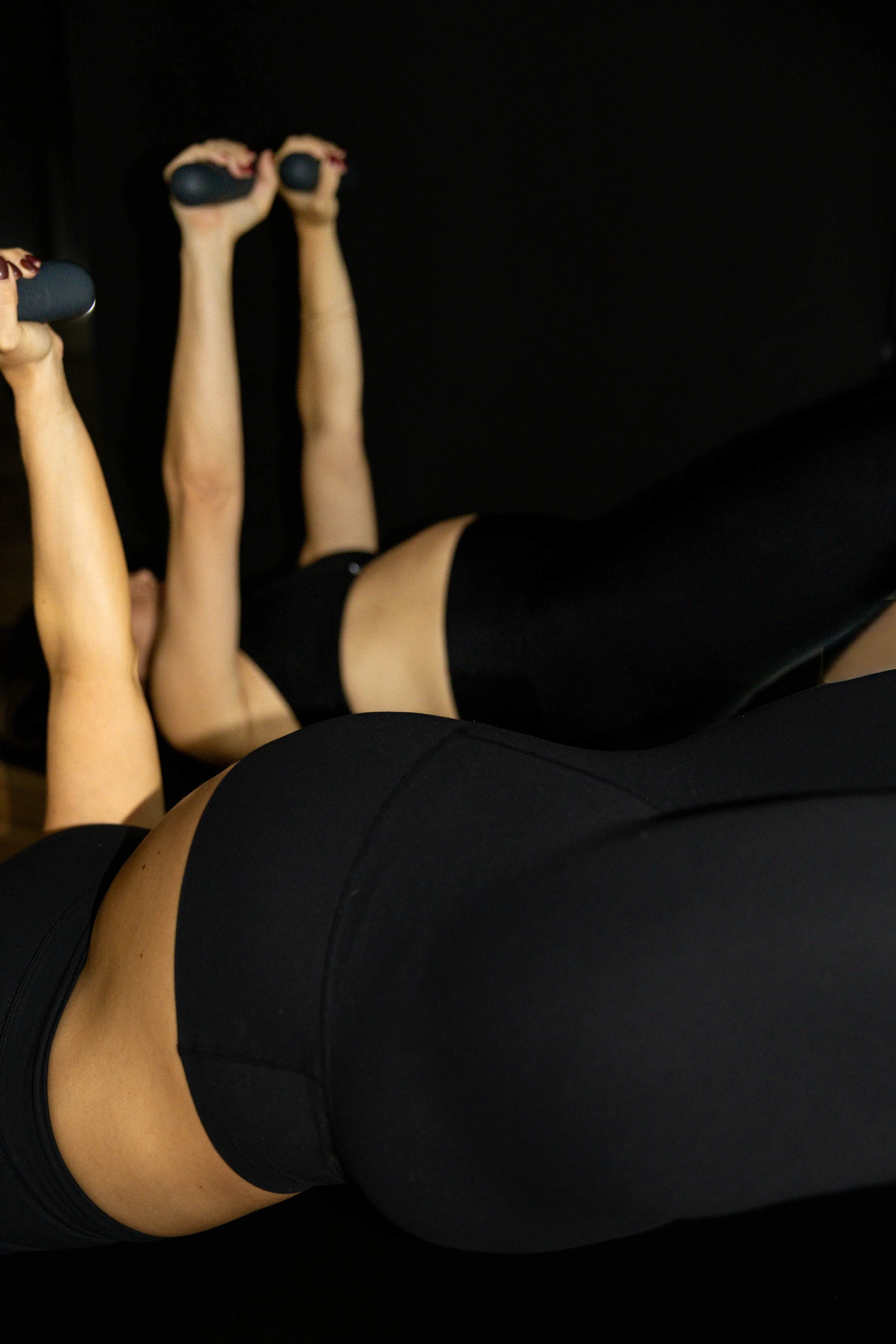
Headrest up or wedge under your back if needed
We aren't on our backs long enough for it to be an issue — but if you feel uncomfortable, prop the headrest up or use a wedge. Follow your body's signals.
Press instead of jump, or use unilateral kicks
Any jumpboard exercise can be done as a controlled press rather than a jump. If jumping still feels good, you can also use single-leg kicks if bilateral kicking creates pressure in the abdomen.
Shorter holds, smaller ranges, lower intensity — progress based on control
REFORM can overload the core early postpartum. Start with shorter holds, smaller ranges of motion, and lower intensity. Watch for coning, pressure, or a feeling of disconnection — these are signs to dial back. Bend your knees, reduce range, and take more breaks. Progress based on what you can control, not on a timeline.
Leaking, heaviness, or pressure means scale back immediately
Leaking, heaviness or pressure in the pelvis, or discomfort during any movement are signs that the load or position is too much right now. Modify immediately — these are feedback, not failure.
More support is better early on — avoid very light springs
Early postpartum, more spring tension provides better support and reduces the stability demand on a core that's still rebuilding. Avoid very light spring settings that require high core effort to control — add springs rather than removing them until strength returns.
Avoid pressure at the incision, modify deep flexion, progress slowly
Avoid any movement that creates pulling or pressure at the incision site. Modify deep flexion or intense core loading, and progress slower than you think you need to. The deeper layers of tissue take significantly longer to heal than the external scar suggests.
Shorten sessions, take breaks, stay consistent over pushing hard
REFORM is an intense format — and that intensity is amplified postpartum by sleep deprivation and recovery demands. Shorten sessions if needed, take more breaks, and prioritise consistency over output. Showing up regularly at a lower intensity is always more valuable than grinding through depleted.